
OIMACHI – SHINAGAWA CITY


1.Project Overview & Objectives
Learning about urban development from Japan and overseas:
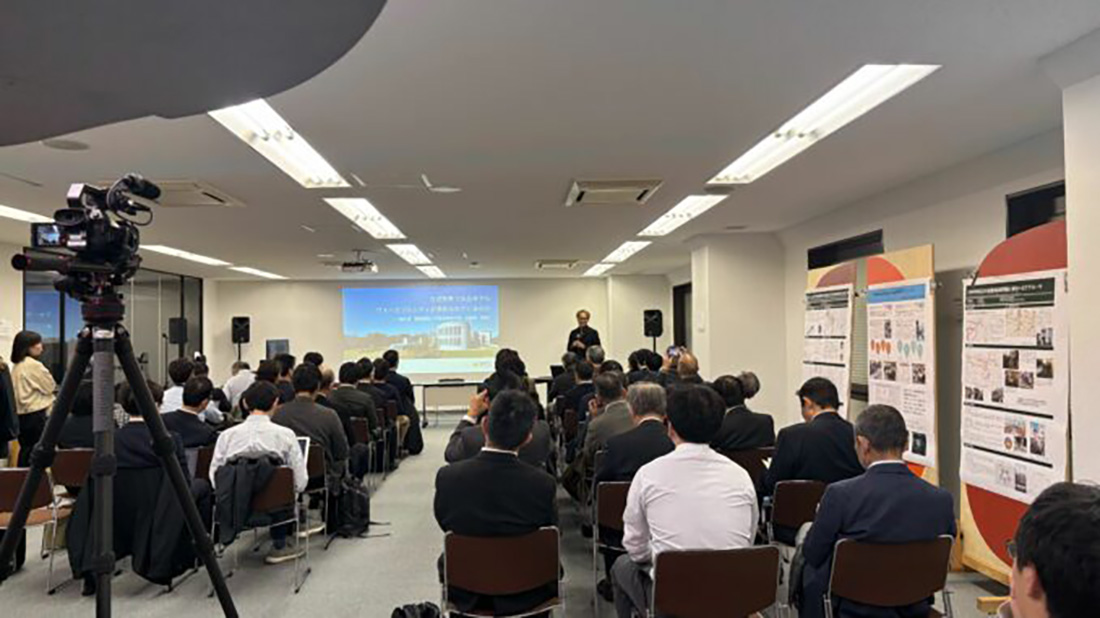
We will hold classes on urban development to provide opportunities for local government, residents, and business operators to learn information, knowledge, and innovative initiatives from Japan and overseas on promoting walkable and enjoyable cities. We will also discuss the issues for and approaches to urban development that makes people want to walk around.
Exploring the walkability of the city:
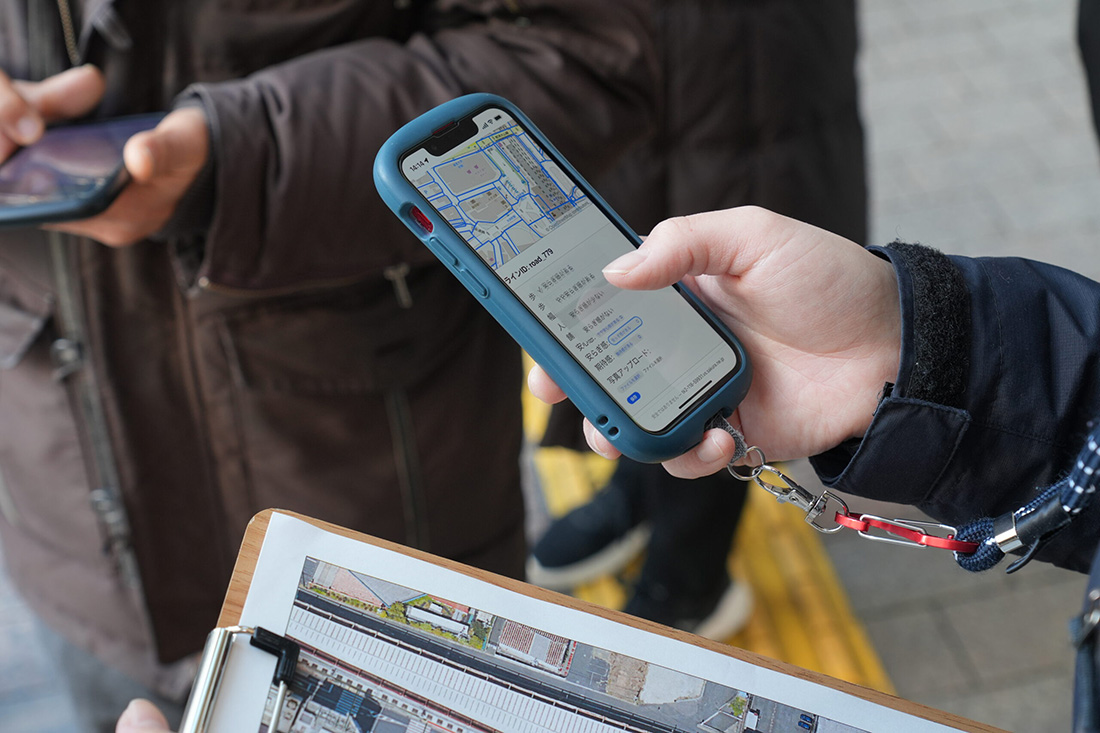
We will hold participatory workshops for observing the walkability and enjoyment of walking in the target areas and discovering the challenges and possibilities of these areas. In addition, with the participation of residents, we will use GIS tools to collect and share information on those topics so that it can be used immediately in urban development workshops.
Showing the rhythm of the city with analysis of big data:
We will integrate multi-source geospatial information such as city planning data, social media text data, and people flow data into a two-dimensional/three-dimensional data platform to visualize spatiotemporal movements of residents and visitors in the target areas and provide content to the Tokyo Data Platform.
Creating an action project:
We will examine a project to shape the urban development policy and GIS tools to support it, develop prototypes based on the knowledge obtained from the urban development lectures and walkable city design workshops and the 2D/3D digital information obtained, and conduct social demonstration experiments.
2.Past Efforts
Sharing a vision of urban development:

Shinagawa City has been considering a project to create space for pedestrians on Oimachi Ekimae Chuodori. As a result of the comprehensive review of the related information, knowledge, and efforts, we decided to propose "Walkable City" as the vision for Oimachi's urban development, and widely publicized this through lectures, resident workshops, technical seminars, and other means. As a result, it has gained broad awareness among residents and local businesses.
Creating walkability indicators:
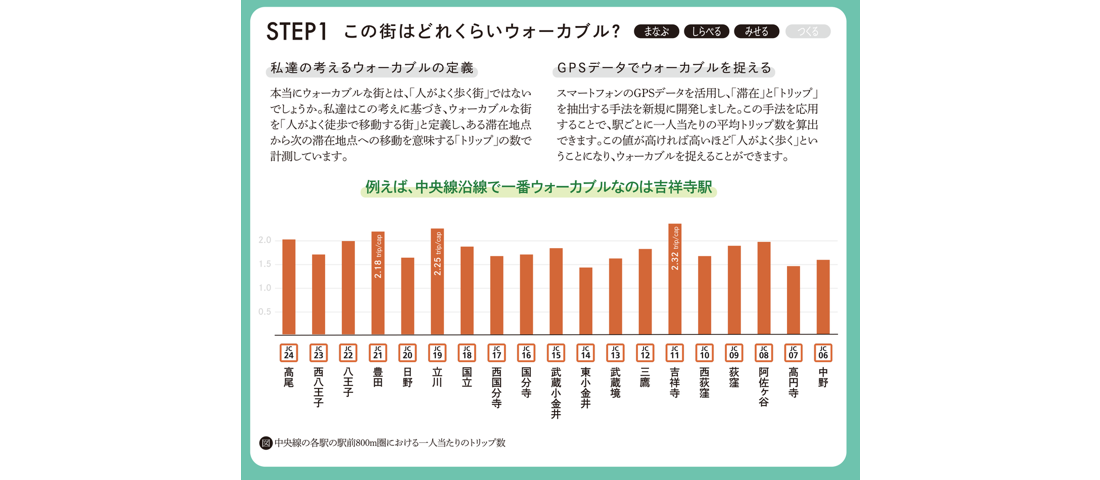
We systematically organized the walkability index reported in projects by the Ministry of Land, Infrastructure, Transport and Tourism and academic research. After examining a large number of evaluation items, we selected survey items using the two axes of "walking ease" and "walking enjoyability," as these are easy to understand and easy to use, decided on the method for conducting evaluations, and verified their practicality in the field surveys. Using people flow data within 800 meters of station areas, we ranked walkability for 1,000 stations in Tokyo and Kanagawa Prefecture. Oimachi ranked 779th, revealing substantial room for improvement.
Developing tools to support urban walking:
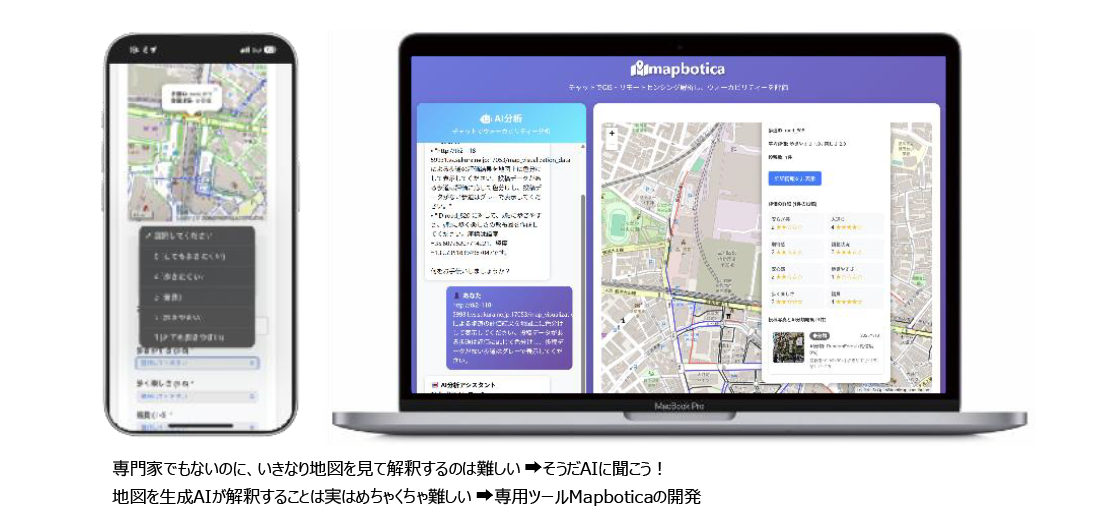
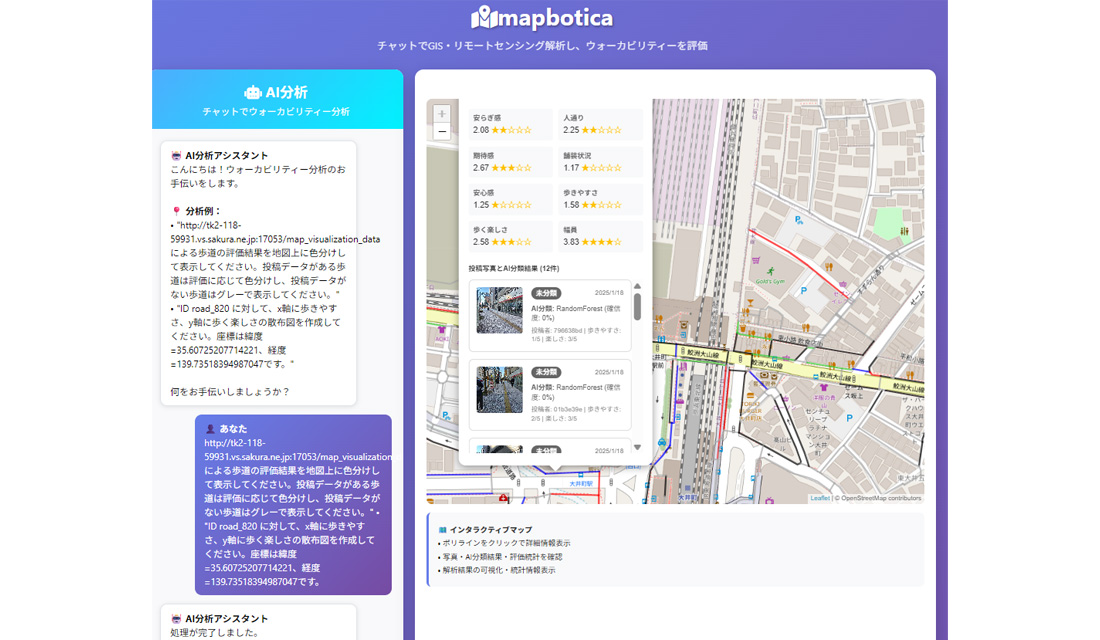
Through the development and practical application of a GIS tool for walkability surveys using smartphones and the cloud, the results of field surveys can now be shared directly via the cloud. Additionally, generative AI makes it possible to put walking ease and enjoyment into viewable form and provide on-the-spot support for resident workshops, thereby allowing resident-participatory dialogue-based urban development efforts to be moved forward in earnest.
Development of a 3D data platform (UMEX-4D):
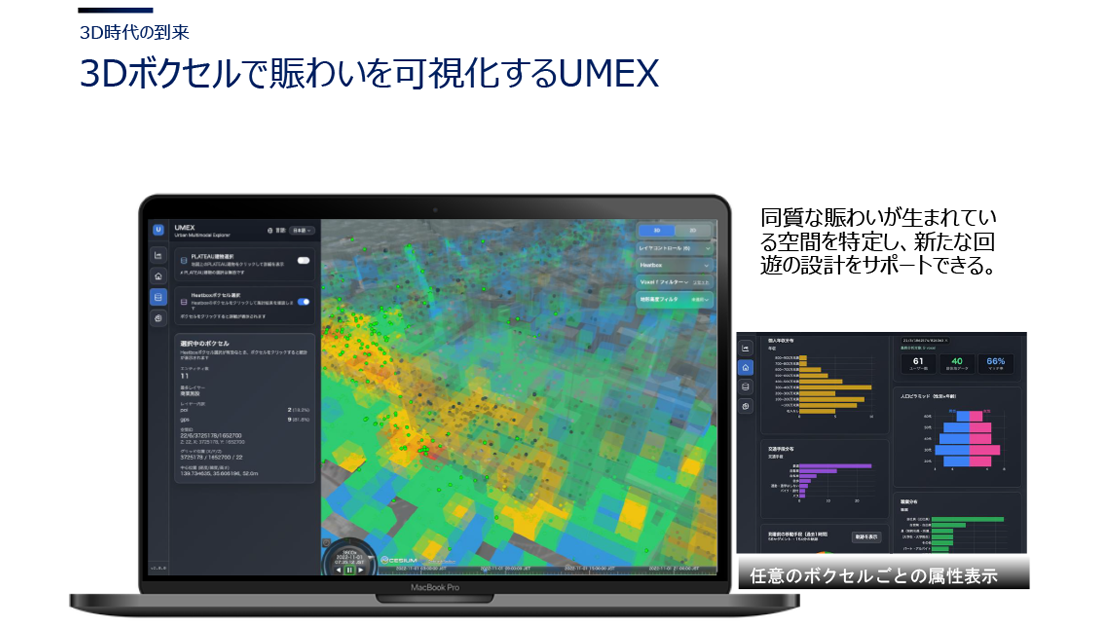
We selected basic technologies for visualizing and analyzing walkability data and developed a platform (UMEX-4D) that can analyze data by adding "height" and "time" to conventional flat data. We integrated human behavior data (from GPS) and city destinations (POIs) on a 3D city model (PLATEAU), enabling them to be displayed three-dimensionally. This makes it possible to dynamically analyze the use of high-rise buildings by floor, the flow of visitors by time of day, and the impact on surrounding city blocks.
3.Upcoming Schedule
- As this fiscal year marks the final year of the project, we will use the data accumulated to date and, through resident workshops, advance initiatives focused on the practical implementation of urban development.
- Workshop held under the theme “Envisioning Oimachi’s Future Together” (held on June 16, 2026)
- We worked in stages to use tools with different characteristics (e.g., paper maps, 2D/3D digital maps, and a people flow simulator) and discussed how the scale, use, and placement of facilities affect visitor numbers. At the same time, we examined the effects on workshops from the use of each medium.
- "Oimachi Landscape Re-reading Workshop": A workshop for considering future landscapes by bringing together photographs of the past and present (held on August 29, 2026)
- While looking at photographs of the past and present, participants shared their views on the town’s appeal and memorable landscapes, and considered what kinds of landscapes they would like to see in Oimachi in the future, as well as efforts they would like to engage in.
- Investigating how to facilitate an urban development workshop using generative AI (scheduled for early October 2026)
- Our independently developed generative AI, mapbotica, will be introduced into group work in order to reduce facilitator-based differences in progress and concretely confirm the effects of data-driven support.
- Support for a design workshop using a people flow simulator (scheduled for early December 2026)
- By combining generative AI, 3D maps, and a people flow simulator, we will use visual simulation to confirm how facility placement and pedestrian route design affect people flow.
- Compilation of results from the Digital Area Design Workshop (scheduled for January 2027)
- We will expand the functions of UMEX-4D and move forward with social implementation. Based on three core functions, we will develop a 3D GIS data platform (UMEX-4D) and conduct an integrated demonstration.
- Fiscal year-end / project completion report meeting (scheduled for March 2027)